Showing posts with label Church. Show all posts

Tuesday, September 19, 2006

Response to Anne on Jesus Camp

Okay, the third time I tried writing this. Anne Marie said this. To which Jaime brilliantly replied this. In response to an up coming documentary called Jesus Camp.


So what's my take? I find that stuff scary, repulsive and...scary. I feel so bad for those kids, they're growing up learning to hate other religious traditions, to see that confrontation not dialogue is love and to see time as running out so patience is not a virtue anymore, especially when it comes to people's souls. This is so the opposite of what I want my girls to grow up with, and it's part of the anxiety I have with our current main stream evangelical church. They don't talk in the rhetoric that is seen in the clips from the video, if they did I would run for the hills, but they do constantly push "making a choice for Jesus..." getting your friends to "make a choice for Jesus..." and all that other evangelistic rhetoric that I'm very uncomfortable with.

We often find ourselves correcting certain aspects of the church's teaching, and one of my greatest fears is that she grows up to be like them (as in sign on their dotted theological line). So why do we go there? They fit a need that we had when we left our old church. They were huge so you could get lost if you wanted to, but they also had lots of kids for our girls to play with, and they have so much fun. And even though I disagree with some of what the church teaches, I love the people. They are genuine in their belief and sincere in their love for other people, and if the church leaders would help facilitate it, they have the money, resources and desire to make a huge difference for the poor people on the west side of Columbus

For our kids, I want them to grow up and love all people regardless of their religion, etc. I want them to respect all forms of spirituality that are positive and acknowledge those forms that are negative. I would love for them to grow up directly following the teachings of Christ, but if they grow up and choose a different tradition, I hope they continue caring for the poor and needy, fighting injustice and loving and respecting all people. That's my main goal for them. I don't have verses(sorry Jaime!) not because they don't exist, but I don't have the time or desire to find them.

Anne's post sparked a lot of other ideas which I'll write on later, but she wanted direct feedback on what we do/desire for our kids. So there you go.

P.S. I echo Jaime's apology for being a self-righteous bitch (maybe that doesn't work for me. Anne, just insert your own gender appropriate cuss word for me). I'm sorry I made you feel guilty, unable to speak your mind and disagree. I'm sorry for anything we've done that wasn't truly loving you, but seeking out a righteous image. NOW, we don't judge anything you do and part of why I am honest with you about so much of my questions is because I want to correct all that image, judgment, etc. Truly sorry.

Monday, August 28, 2006

How to Control the Masses Without Really Trying...

Have you ever read a book that everyone is talking about, and says it's completely amazing, but when you read it you see something completely different and so appalling you're amazed people get away with it? That's how I feel about A Tale of Three Kings by Gene Edwards.

A good friend of mine had recommended it and my dad had it on his book shelf, so I borrowed it. The reviews on Amazon and elsewhere that I've read on it all talk about how it's a great book for people who are suffering. People who maybe are (or recently have been) under tyrannical/abusive relationships with other believers or authority figures in church. But when I read it, I didn't walk away feeling better about myself or challenged to live a better Christian life, as many of the reviewers said I would. I walked away from it thinking, "Are people really buying into this bullshit?" (Sorry about the language, but it's really bugging me).

Here's my take on the theme of the book: if you're in a bad relationship in a Church or if you're in a church with an abusive pastor; sucks to be you. Grin and bear it, you can't leave or offer up any sort of dissent because that rebellion comes from ego, and if you give into that rebellion you're no better, or could potentially become that person. No wonder this book is being taught from the pulpit! It essentially says put up or shut up. You can do nothing about your situation, because the person who is abusing you might not really be abusing you in God's eyes, and the big man upstairs isn't going to tell you. So don't rock the boat, if you do you're bad!

Pastors are handing out this little $9 booklet left and right and I can't imagine why. You have problems with what I'm doing? I'm sorry, I'll do better. Here read this nice book, it'll help put things in perspective and quell any further criticism you may have. Wow, you just came from an abusive church so you're kinda' grumpy, why don't I not acknowledge your abuse and help you work through it; instead give you this nice booklet that tells you not to be too critical because I don't need another person to rock the boat here.

I mean, come on people! The one group of people that Jesus was critical and harsh with were the religious leaders of his time. The implications of many of the stories of demon possession is that the very religious system that Jesus was challenging was the enabler of the demon and they could be seen as in collusion with one another. Didn't the Reformation come from people challenging the abusive authoritarian powers of the Church at that time? I find it telling that this book is getting mass publication and reading during a time when many people are seeing a new reformation on the horizon. It seems a thinly veiled attempt at establishment trying to quiet the mass of those who would seek to challenge the answers of an age that is increasingly becoming irrelevant.

Anyway, sorry, rant is over...

Oh, and can you really trust someone whose glossy looks like this?

Friday, August 25, 2006

A New Christianity for a New World

So I just finished this book today. Generally speaking, I don't care for Bishop Spong's writings, his scholarship is dated and his treatment of the Bible is, at times, too reckless. But let me say that I really enjoyed reading this book, and I would recommend anyone who is looking to expand their view of Christianity and get a vision for a new type of Church to read this.

Once again, I don't agree with everything that Spong argues, especially in the first part of the book. His deconstruction of Theism is, for me, deeply flawed. I have run into too many "coincidences" in my life, to believe that God is completely uninvolved, but I've also run into too much suffering to believe that God is completely involved (at least to the degree that most mainline evangelical Christians believe). Spong continues to be, for me at least, too far out there in his dismissive nature of the role of the Divine in our everyday lives.

But the last half of the book, his reconstruction of Christianity, evangelism, prayer and the Church is completely compelling. Ironically, in this section, many of his conclusions, I would like to take even further. If you already have problems with the way Christianity currently operates, you could even skip the first six chapters and start with his vision of Christianity beyond "Theism" in chapter seven. Or if you're not sure, or appreciate new challenges to your way of thinking and understanding the world take the time to read from the beginning, it's worth your time.

If nothing else, even though much of Spong's methodology doesn't resonate with me, I'm appreciating more and more his willingness to think outside the box that we tend to put God into. His challenges to traditional understandings push me to reconsider the foundations upon which my own beliefs and faith issues stand. If you come from a traditional background but have yet to find a Christianity that is significant to you read it today.

Saturday, August 19, 2006

Thoughts On Various Profound and Unprofound Topics

Jesus never publicly declared who he was, and never gave any direct formulaic argument on his relation to God, or other apologetic discourse. Instead he said that his actions told who he was and all his teachings had to do with how we treat other people. Therefore, if we try to convince people with apologetics, or try to make a case for Christ, etc are we committing a sin? We aren't following the example of Jesus who we're supposed to be imitating nor following his teaching of letting our good works be seen by men that they might glorify our father in heaven. I find it interesting that we use the teaching of salt and light, being a city on a hill and those other images to teach that we should be "witnesses." In reality, those teachings are purely ethical; they were meant to encourage us to righteousness (deeds) not formulaic arguments on who Christ is or the four spiritual laws as a way to eternal life.

I'm growing increasingly uncomfortable with the label of Christian for myself. There's just too much baggage with it (both personally and within society). So I offer the new non-threatening label: Puppy Pals of Jesus... of course, if your allergic to dogs that might have it's own baggage.
Seriously, as far as labels go here's my new one for me: Existential Christ Following Humanist.

The first season of 24 has too many plot holes, are they covered in the next season or just dropped? If they just leave them, I don't know if I really like the show, too sloppily written...also too many camera men were seen on camera, aren't they supposed to be behind the camera?

Do people make gay jokes because they're uncomfortable with their own sexuality? Is it really that scary that you have to demean the people by making them a by-word for something bad? That's so hetero!

Brice, you should just give up on MSN and start over on blogspot. Come to the new evil empire: Google! I use their search engine, blog, calendar and e-mail. I no longer have a soul, but I'm very organized (not to mention addicted to Google Earth).

Monday, August 07, 2006

Back to Matthew 18

Okay, go here and here to see the previous posts on Matthew 18.15-17 also see the comments left by Lauren especially her post on her on-line journal that I linked to in the second post.

I've been wanting to go back to this passage and creatively reinterpret it, but I had been delaying because I couldn't really find another interpretation other than the mainstream interpretation. If that interpretation is accurate, as I posted before, I really reject that train of thought as not being a valid teaching of Jesus. However, having read Rabbi Greenberg's book on Homosexuality and his description of the Jewish view of the Bible has inspired me to follow Lauren's suggestion and to look for a different interpretation.

Having said all that, I feel like I need to be completely honest here. I still find verse 17 problematic as a teaching from Jesus. The use of the Greek word translated here as "church" (ekklesia) is used in all of the gospels only one other time also in Matthew (16.18) which is best understood as a comment from Jesus that a new community will be built upon Peter's declaration of Jesus as messiah. But if we read ekklesia in Matthew 18 as the specific community built around Peter you're still dealing with the Church, and you have the problem of Jesus giving advice on how to run the Church many years before it began.

Also, I have to admit that the reading of "gentiles and tax collectors" that I propose is unique to the meaning of gentiles and tax collectors as Jesus employs those terms, especially in Matthew. These terms are used in Matthew specifically to represent those who are wicked, evil or highly impure and should be avoided. So that, if Jesus did give this teaching about his coming community, it really could have no other meaning than to make the unrepentant outcasts. This seems to me to go against everything that Jesus represented in his life and other teachings...that is that God is found in the outcasts, forgiveness is unending (for instance the question from Peter in Matt 18) and other teachings of acceptance and love.

However, if we remove only verse 17 which is the only problem verse in this scenario (it mentions church and gentile/tax collector). The rest of the passage makes much more sense. Once the passage of condemnation is removed, the statement of wherever two or three are gathered connects directly to the number of witnesses needed as Jesus quotes Deuteronomy in 16 and the connection to the following question of forgiveness by Peter, flows nicely as well. All of this leads me, if I'm going to be honest, to continue to argue that verse 17 is added in by a later scribe seeking to justify their harsh treatment of dissenters (Christian scribes are notorious, btw, for amending texts to suit their theological needs).

But there is still a part of me that says that this is scripture, and should be treated with respect and, even so called "trouble passages" should be left in for a possible new interpretation. So I offer the following re-reading in an attempt to leave this verse in the text and still understand it within the larger framework of Jesus' teaching.

It must be pointed out that the passages of binding and loosing, and where two are gathered in the name of Jesus are specifically referencing forgiveness (or condemnation) of the offender's sin (see John 20.23). Jesus is telling the apostles that they have the authority to condemn or forgive anyone. As far as Jesus is concerned, their decisions are final. So, when immediately following this passage, Peter asks Jesus how often they should forgive, it seems likely that he is seeking further guidance on this teaching. Jesus' response is then a clarification on his earlier teaching--the clarification being to always forgive.

Therefore, the command to treat those Christians as "gentiles and tax collectors" seems to me not to encourage excommunication, but rather shows a status within the community. They should be regarded as weak in faith or as young Christians (see Romans 14) which their actions reveal them to be. To me it seems counter productive to keep people from the communion table, let alone fellowship with the community. It is, in a sense, declaring someone a non-Christian. It is a stance of unforgiveness, which goes against Jesus' clarification with Peter later on. Therefore to use this passage as a guideline for church discipline with some form of disassociation with the believer is actually, in my opinion, to loose the meaning of the passage.

Thursday, August 03, 2006

A New Form of Church

What if we totally changed the way a church looked.

What if church services were agreed upon times to...well...serve. Like instead of meeting in the same building every week singing a variety of the 20 songs that the worship team knows/likes (I can say that because I'm on one of my church's worship teams) the church met at a park where the homeless are known to hang out and they bring free food and actually eat with them and spend time getting to know them.

What if the next week the church service was on Saturday and they went to the home of an elderly widow and helped her clean her house, bring her food and spend time in fellowship with her.

What if instead of spending hundreds of thousands of dollars on building a new super huge, state of the art building, the church spent hundreds of thousands of dollars on helping people pay their mortgage, get out of debt, eat, get medicine, etc. Do you know how many goats the average church could buy for people in third world countries if they just got rid of their building funds? I don't either, but I bet it would be a lot. What if the amount of time and energy various churches spent on building campaigns was instead spent on feeding the poor campaigns?

Do you think you could get people to come to those churches? What if you said to your friend, "Come to my church our service this week is eating with the homeless at Goodale Park, and next week we're going down by the river and doing the same thing, the Saturday after that our church service is at Mrs. So and So's house. Her husband died last year and she needs some help done around the house, and some people are making her food..." I would like to go to that kind of church...

Thursday, June 01, 2006

Accountability, Church Discipline and Jesus

Recently, a church in Texas has made the news because of the "controversial" way they handled a certain church discipline. Because I'm not familiar with the details of the situation, I'm not going to say anything specific about it, but it does bring up certain questions I've had about accountability and what the Bible says about it.

The standard passage used by churches to help define the method by which they perform official church discipline is Matthew 18.15-17. Essentially there are four steps:

  • Correct the sinner privately, if that doesn't work:
  • Correct the sinner with another person, if that doesn't work:
  • Tell it to the church, if that doesn't work:
  • "let him be to you as a Gentile and a tax collector" (vs. 18)
When churches want to use this passage to defend their actions against a member, the first question I want to ask is this, "Does it strike you as odd that Jesus is talking about "Church" discipline years before the Church was ever in existence?" They usually don't mention that this teaching in Mathew is in a really wierd place right between Jesus' parable of the shepherd going out to find the one lost sheep and Peter's question about how often he should forgive someone (70 times 7; i.e. always). Suddenly, in between teachings of forgiveness and reconciliation is a teaching about how to kick someone out of a church? A church that doesn't exist? It seems to me that this passage was added later and should not be used as a teaching from Jesus himself.

(My wife is lecturing me right now about slippery slopes and all that, but I am tuning her out. Honey, you can't avoid something just because it's a slippery slope. And I don't know why you're using that phrase anyway because you hate it.)

Anyway.

Many people respond that the Church needs some way to hold people accountable for their actions. Does it really? The only reason (that I can think of) for this would be to maintain power and control. If you were to look at all the times in the bible the word "account" (i.e. give an account, be accountable, etc.) is used, never once does it mention people being forced to give an account to each other for their sin. Instead everyone has to give an account to God. It's really between the person and God. When it does talk about people giving account to each other, it is always confessional and always initiated by the sinner. It seems to me, from my experience at least, that people who want to initiate some form of accountability on someone else are usually the most judgmental and least loving. The powers that be use it to maintain a power structure which usually puts them at the head.

One last thing on the Matthew 18 passage: what does it mean for Jesus to tell his disciples to treat the unrepentant sinner as a gentile or tax collector? He was notorious for his association with the outcast (i.e. gentile and tax collecter) and not disassociating himself from them, but accepting them where they were! This statement is so out of character from everything else the gospels tell us about him, it makes me suspicious...any thoughts?

Wednesday, May 31, 2006

Will you be left behind?

I offer for your horror the following article:

Mega-church minister linked to paramilitary video game

As far as I have been able to research, everything in this article is accurate. The company web site is here.

Let me just say a few things:

  1. I don't believe in the Rapture and find the escapist dispensationalist theology worthless
  2. My seven year old can write better than Tim Lahaye and Jerry Jenkins
  3. I'm a passivist because Jesus was one too
    1. Jesus was freakin' murdered you idiots! He didn't walk around with a freakin' sword stabbing the random people who disagreed with him, or the Roman soldiers who were trying to kill him! Are you so damned stupid you can't get that through your thick violent skulls !?!
  4. It's people like these that give Christianity a bad name...if there is a hell, I can almost guarantee that Lahaye and Jenkins will be there....without butter! (sorry Cold Comfort Farm reference, if you haven't seen it, do. The best scene is when Ian McClellan is preaching a hell fire and brimstone message. I repeated that scene about three times and am still laughing.)
  5. This is one of the many reasons that the Left Behind books are more dangerous to Christianity than the DaVinci Code.
  6. That's all I can think of now...

Thursday, April 20, 2006

All Apologies

The past few days a Christian student group (Chai Alpha, I think) has been out on the oval handing out fliers and free Bibles to people passing by. Meanwhile they have someone nearby giving a dramatic reading of the Gospels. Part of me finds this rather inoffensive, it's certainly less offensive than most of the "Christian" activities on the oval.

But another part of me finds this really offensive. It's the part of me who has to deal with my friends who are offended by this stuff. One of my Jewish friends again vented to me because of an exchange she had with the people handing out the Bibles. She is so tired of the Christians on the oval trying to force feed Christ into her life. She's said there are parts of Jesus' teachings that intrigue her, but those people make her really not interested in learning anything because they're not willing to learn anything about her faith.

She's a little high strung and is becoming more in tune with the teachings of Judaism and how they differ from the traditional Christian point of view. Combine that with several bad run ins with arrogant insensitive Christians and I understand why she's so pissed off. I initially just chalked her current frustration up to all of this and thought that in a normal scenario this handing out of Bibles wouldn't have bothered her a great deal.

But then she brought it up to another one of my Jewish friends, who is not all that observant, and she felt the same way. This made me back up and re-think this whole thing. This other person is pretty laid back and easy going, so if it's offensive enough for her to say something, then there must be something wrong.

Thinking about it some more and dialoguing with my friends I decided this is why it's offensive: There is a feeling of superiority to these actions. The fact that the people on the oval don't know the students they're trying to talk to shows a lack of love and true concern for people. This combined with their pushiness makes them highly offensive. Put it this way, what makes the Jehovah Witnesses' and the Mormon evangelizers so offensive? Isn't it because they're strangers who invade your space claiming to know just what you need? If the Mormons were to be passing out the Book of Mormon on campus wouldn't those same Christians be offended? I think they would.

So anyway, all I could do through all of this was acknowledge my friends' anger and frustration and apologize for the ignorance of many Christians. I hope that this will at least help them to not hate all Christians.

Sunday, March 26, 2006

Where's the Middle?

The Other Paper, my local "alternative paper," just ran an article this week called "The Dwindling Religious Middle." Apparently it is becoming nearly impossible to be religious and politically neutral in this day and age. This is troubling for me. I see most everything that has ever gone wrong with Christian history as a result of mixing politics (or political power) with the religious.

Constantine endorsing Christianity, and the chaotic power struggles that happened as a result of that decision immediately after, are typical of what happens when the devout gain political clout. Much of the suffering of the Medieval period were less the result of religious sincerity as political maneuvering. Protestants cannot ignore the power struggle that laid behind much of the splintering of the Catholic Church. Throughout all of this people were being killed by "devout" Christians, not realizing that Jesus taught to love and not kill.

In my mind, Jesus himself went out of His way to be apolitical. Challenged by all the political parties of the day to endorse their movement, He essentially called for another way: love your neighbor. In the challenge from the Herodians where Jesus famously says, "Give to Caesar that which is Caesar, and give to God that which is God's" isn't He essentially saying, "Don't worry about the government, worry about your neighbor"?

The most political act He could have made within Judaism at the time, was to publicly say, "Look, I'm the Messiah! Follow me to God's Kingdom!" But He never did. He walked away from political power and trusted in God's power instead. He worried about feeding the poor, clothing the naked, healing the sick and not about legislating morality. That's what those Pharisees who Jesus challenged wanted to do. I find it so completely ironic that those of the religious right who are so tied to politics, money and influence will do the same thing while jealously defending some outdated unimportant doctrine like the rapture.

Yes, I lean liberal and I would be equally critical of any religious movement that is closely tied to the Democratic party, but there isn't any really. For some reason conservative religiosity (Pharisees, the Fundamentalists, etc) seem to be more connected with politics. Why is that?

Sunday, February 26, 2006

Control Thyself


Moira is learning about the Civil Rights Movement in school. She came downstairs the other day and said "Did you know that Martin Luther King Jr. and E.D. Nixon weren't sure that the bus boycott would really happen?" My first thought was "E.D. who?" My second thought was "Oh, of course, E.D. Nixon, the head of the Montgomery branch of the NAACP at the time of Rosa Parks' arrest." Okay, I lied, but like you knew that either.

Anyway, one of the books she's reading is called Oh, Freedom! and it's a collection of children's interviews with people who experienced segregation and/or the events of the Civil Rights Movement. One woman, Ruth Jackson, talks about a kind of youth protest school she attended. They practiced protesting while others in their group pretended to be the white people harrassing, threatening and actually spitting on them. If you reacted at all, cried, fought back or anything, you weren't allowed to march. And you had to be neat and well dressed. All this so that when they did march they were absolutely above reproach. Nothing about their own behavior or dress could distract from their message. And all their white attackers could do was demonstrate their own bad behavior and vicious hate. (By the way, Ruth Jackson was only in the eighth grade at the time. Unbelievable!)

I've talked before about my respect for non-violence and the courage of people like Gandhi, Martin Luther King Jr. and countless others throughout history who have put this difficult teaching of Jesus' into practice. But as I read this woman's story a different application for non-violence came to mind. It can be summed up in Gandhi's statement: "You must be the change you wish to see in the world."

Basically what has become a burden on my heart is that those of us who want to reform the Church, or have rightly criticized the Church for their harsh treatment, and lack of understanding have the extra responsibility of actually not being harsh back to them. We can't criticize them for their closed minds and harsh words if all we do is return fire. We must turn the other cheek to their agression and move forward boldly above reproach. The higher the standard of respect and dialogue that we reflect in our lives will only serve to expose the lack of respect and dialogue in their lives. The result being that those who we truly wish to change (the everyday people of the world and Church) will see our good works and praise our Father in Heaven.

This high road often sucks, it might mean getting slandered, verbally abused and attacked, but that is the example of Jesus. As we seek to criticize those who hold the Church in their power, we must be careful not to move from healthy critical dialogue to overly harsh attacks. Trying to keep tax collectors, whores and just general sinners as friends, we must choose our battles wisely and take the high road as often as possible.

Did Jesus rebuke people? Sure, usually the leaders of the Pharisees for not obeying their own commandments. They were the ones in control, the ones giving people the heavy burdens while they raked in the cash and the social and political power.

Based on Jesus' example, I think there is a place for harsh criticism of those doing damage. But we need to save our "attacks" for the global leaders that hold sway, the people that line their pockets with money and power while sending the Church in damaging directions. We shouldn't be judgmental of local pastors, worship leaders and congregations who are being swayed by global leaders. Rather we should be working with them, encouraging and persuading in respectful dialogue.

I don't think anything can change without dialogue. Very few people in today's culture are going to be won over by a ranting monologue. Everyone wants to be listened to. Being yelled at or verbally smacked across the face doesn't feel good. Christianity is about healthy relationships (with God and other people) and good relationships are give and take. No one wants to be involved in a relationship where they are never listened to, let alone consistently mocked and belittled.

Sarcasm and insults don't win people over--it only cements their point of view. And who can blame them?

Sunday, February 19, 2006

I've Been Bitten

I have officially been bitten by a bug... the emergent church bug. I feel like I've been an ostrich with his head in the sand and perhaps have wasted too much time. Oh well, must keep moving forward.

I just finished reading Brian McLaren's A Generous Orthodoxy and all I can say is....WOW. It is sort of an affirmation of most everything I have recently wanted to believe, but was too afraid to really say so . . . Afraid of another excommunication and all that.

A little less than a year ago our family left a church that we had been involved in deeply for about 10 years. Some really good and healing things happened there, but in the end it became destructive for us. It was better for everyone involved that we left, and it was very emotional for reasons that won't be delved into here. But you can imagine having to leave behind the only relationships you've had (outside your family) for the past ten years and the life change that throws you into. It was very difficult, but now it's done and Jaime and I both feel so much better for everything we've gone through. We're hoping now to move on with the new relationships we're building and the old we're rebuilding (insert apologies here for completely alienating our families.)

Needless to say everything feels new and we've felt free to relax and explore new ways of thinking and living; to explore things that we'd always felt were right but weren't free to talk about or really live.

So recently I've been spending too much time at a blog called Tall Skinny Kiwi where he recently had a pretty strong rebuke for the Emergent Church in the US. This of course piqued my interest on top of other references this week to the whole thing (how's that for deliberately vague?) and I found their web site. Got my hands on the Generous Orthodoxy book and have been bit.

When I'm bitten by something, I get obsessed with it and have to learn everything I can about it, which means lots of Library books on my book shelf for way too long and Jaime getting mad at me. But fortunately for her, I've got two big projects coming up in school and probably won't have time to hit the libraries. Since our public library seems to be short on titles that the Emergent folks recommend, it will take some time to dig them up (I may just have to buy one or two, heaven forbid).

I'm still not ready to jump in with both my feet, though the pull is very strong. I'm still trying to figure out all the details. Anyway, check them out. Several links are on the left. Enjoy.

Saturday, February 11, 2006

I Like Modern Worship

There, I said it. I like a skillfully produced rock band to lead my worship.

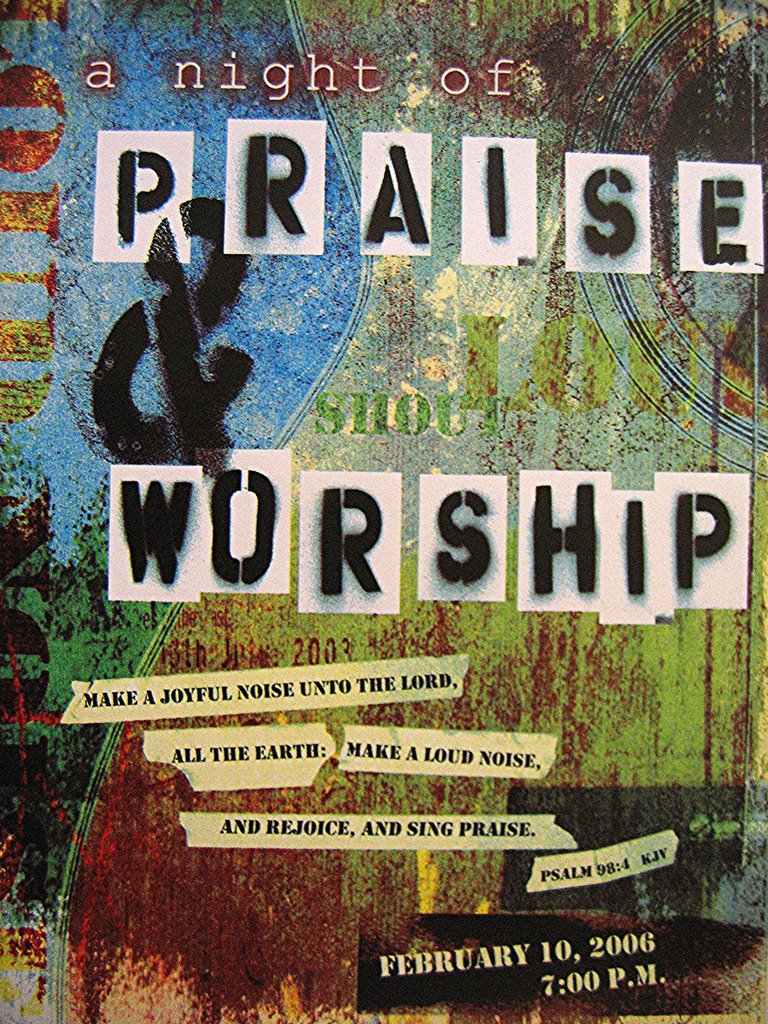
Last night my church had a special praise and worship night and it was loud. It was really loud. It was so loud my three year old couldn't decide between covering her ears and raising her hands. (If you've never seen a three year old raising her hands in worship, you're missing out.) People were just free to worship the way they wanted. Some were sitting, some were standing, some were raising their hands, some were clapping. It was awesome. Just what I like.

The night would have sent my Grandmother, well, either one of my Grandmothers, into hysterics. And I understand that. Not everyone has the same tastes. What matters is if you're really there to praise God. If you prefer hymns, if that's what gets you into a worshipful mindset, cool. Not me though. I want the electric guitarist to peel into a rockin' solo after the second chorus before going into the bridge. I want the drummer on a full set of drums hitting them as hard as he can. I want a piano player that can play circles around Jerry Lee Lewis. And I want a worship leader who's there to worship God with all his might.

I think it's funny (sometimes offensive) when people talk about one genre of music as more inspired, respectful or just plain better for worship. When you look at the history of worship music, there was a time when gregorian chant with multiple parts was seen as scandalous and distracting, let alone an organ. Some hymns were set to old bar room songs because that's what the people knew and could relate to. People are going to worship in different ways because people are different.

So if you like accapella music, cool. If you like a full pipe organ, great. If a full orchestra playing through the old standard hymn book gets you in a worshipful mood, I'm all for it. But me, I want a rock and roll praise band and people in the audience standing up and singing at the top of their lungs while they clap or raise their hands. But, hey, that's just me.

Saturday, January 28, 2006

Dilemma

I attend a rather main stream evangelical church. It's Wesleyan, which I like because of its emphasis on free will and other stuff. That being said there's so much that I believe from my studies in Judaism and the Bible that I know they wouldn't agree with yet. But I love the people there. They're so friendly and open and have that simple faith in God, that I wish I had sometimes, but seems to be impossible to get the more I study and learn.

Anyway, because of this, I find myself increasingly in conversations where the person is talking about something that I totally disagree with, and I find myself with a dilemma. Do I say something or not? By saying nothing, the person assumes I agree with them, but by saying something I risk hurting the person I'm talking to, or even talking over their head on something that is to me trivial, but to them very important. If I value their friendship, shouldn't I be completely honest with them? By not saying anything I feel like I'm lying to them by not being who I truly am. How do I be completely honest with them and not "blow them away"?

*sigh* I really have to figure this out if I'm going to be effective in what I want to do in life. I'll be in these positions for the rest of my life, so I can't run from them. I need some wisdom here folks! Please Help!